Thursday, August 16, 2012

The McKowns of Campbell County

      A few weeks ago I had the immense pleasure of meeting my first cousin thrice removed, Dorothy “Dot” Dobson Ward, a sharp and keen nonagenarian. Memaw and I visited Dot at the home she shares with her son near Palmetto. It was such a short trip there that we agreed it was a pity we hadn’t done this sooner and more often. Hugh Williams, Memaw’s father and my great-grandfather, was Dot’s first cousin and 22 years her senior. She is the last surviving member of a generation that included over 20 cousins, born from the late 1880s to 1919. These 20 cousins were the grandchildren of Leonora Smith and James R. McKown.

James R. McKown was small in stature and never weighed more than
125 pounds. This portrait belongs to Dot, his only surviving granddaughter.

      James R. McKown was born December 21, 1838, the fifth of seven children. The spelling of his middle name appears in his daughter’s recollections as Redford and Radford, elsewhere as Ratherford, but is usually printed as an initial. His birthplace is also a disputed matter. Family lore recounts he was born in Fairburn in Campbell County, but the census indicates he lived with his parents Hugh McKown and Linda Chapman in Henry County in 1840 and Fayette County in 1850. The McKowns may have moved to Campbell County in the 1850s or their land may have been absorbed by the county, as Fairburn’s website tells us:
Early records show that what is now called Fairburn, was settled as early as 1830. In 1833, the town was founded as Cartersville, changing its name one year later to Berryville. … Fairburn’s town charter was enacted by the State Legislature in 1854. The jurisdiction of the town government was set within a 600-yard radius from the railroad depot, this land then being the two counties of Fayette and Campbell.

 Leonora Smith McKown, from Dot's mother's photo album

      The youngest in a flock of eleven, Leonora Smith was born March 18, 1843 in Campbell County to Valinda Trentham and Andrew Smith, who married in 1820. Leonora married James on September 29, 1859, and the 1860 census records the young couple residing near their parents in the selfsame county. When the war came James enlisted on June 6, 1861. He was a private in the Campbell County Guards (Company A, 21st Regiment), part of the Army of Northern Virginia. His younger brother Thomas Jefferson McKown joined up as well, serving as a musician through the duration of the war. James’ wartime experience is best left to the words of his oldest daughter, Virginia (Jennie):
At the age of 22 he enlisted in the Confederate army being among the first to volunteer, notwithstanding the fact that he had a young wife still in her teens and a baby boy. He served throughout the four year struggle and suffered such privations the last year he contracted that dread disease chronic diarrhea, from which he suffered more or less the balance of his life….
 Campbell County and its environs, 1864

      There are discrepant reports about when James fell ill, when he was discharged, and if and when he rejoined. The Confederate roster indicates he was discharged with a disability on October 7, 1862. Leonora’s application for a Confederate pension states he was discharged on February 14, 1862, and was unable to return to service on account of his health. Another of James’ daughters, Alice (Allie), offered a different version of events. It was relayed in a 1975 letter written by one of her nieces:
He became ill in 1863 and was given a furlough because of his illness. He rejoined the army in 1864, but on account of his health (he never recovered from his illness) he was unable to do regular army work but did serve as a courier during the Battle of Atlanta.
      Whatever the differing accounts, there is no doubt the war ruined James’ health and precipitated a long and slow decline. The long-suffering veteran lived for two more decades when, according to Jennie, he was “…weakened by an attack together with other complications [and] fell easy prey to pneumonia. He died January 28, 1883.” In spite of this ailment, James worked first as a blacksmith and then owned a saw mill. He and Leonora had nine children, two boys and seven girls. His premature death at age 45 left her to raise their young offspring by herself. It must have required true grit and faith to overcome these trials of heartache and hardship. Leonora lived the remainder of her days as a widow and passed away January 29, 1937, exactly 54 years and one day after James’ demise. Leonora’s 93 years uniquely paralleled the life of the county where she was born and bred. Campbell was carved out of neighboring counties fifteen years before her birth and merged with Fulton six years before her death. In the city cemetery of Campbell County’s former seat Fairburn, Leonora and James were laid to rest.
Lord we married young and stayed where we came from
And gave those children everything we had
Will you stay with me in my time of need
Though it seems we had such little time for us.
Will you say to me a little rain’s gonna come
When the sky can’t offer none to me
Cause I will come for you
When my days are through
And I’ll let your smile just off and carry me.
—Ryan Adams, “In My Time of Need”

Saturday, June 9, 2012

Carolina in My Mind

      My great-grandparents Hulett Hall Widener Sr. and Rubye Mae Cochran took my grandfather Hulett Jr. on a trip to North Carolina in September 1936, when he was five years old. They may have been visiting friends or family, or they may have taken a vacation. These are some of the pictures from their Depression-era road-trip.


Friday, June 8, 2012

How Green Was Their Valley

      The first of my Widener ancestors to settle in Georgia came from Fairfield County, South Carolina, in the 1820s. My great-great-great-great-grandfather Henry Widener was born in 1791 or 1792 and married Nancy Kuglar in 1814. There were two daughters by the time the family migrated, probably along the Fall Line Road from Columbia to Augusta and across the Savannah River into Georgia. It was another 130 miles through piney woods to their destination, Henry County, where they established themselves as farmers near the Ocmulgee River’s headwaters.


      The lands they settled were former Creek Indian territory ceded to Georgia in the Treaty of Indian Springs on January 8, 1821.  In the resulting bonanza neither the Wideners nor Nancy’s younger brother James David Kuglar, who migrated with them, won lots. Perhaps they purchased land from the grantees or became tenant farmers. (James won a tract of land in Muscogee County in the 1827 lottery but it appears he remained in Henry and was married there a year later.) 
      Nancy gave birth to three sons beginning with my great-great-great-grandfather John D. Widener on June 22, 1830. Joseph M. and Andrew J. followed around 1832 and 1833. There was also a daughter, Mary Ann, born around 1835. From the 1850 census we learn the value of Henry’s real estate was $3,830 and that he was unable to read or write. It seems however that his wife was literate. The three sons married in Henry County in that decade; John was the first, wedding Nancy Amanda ‘Mandy’ Dickey on December 28, 1854. Nancy was the daughter of a quite elderly Irishman (he was 61 when she was born on October 26, 1835) named Thomas and a Virginian named Martha, 20 years his junior. They too moved to the county in the 1820s from South Carolina and were of modest means: in 1850 and 1860 Thomas valued his property at $200.

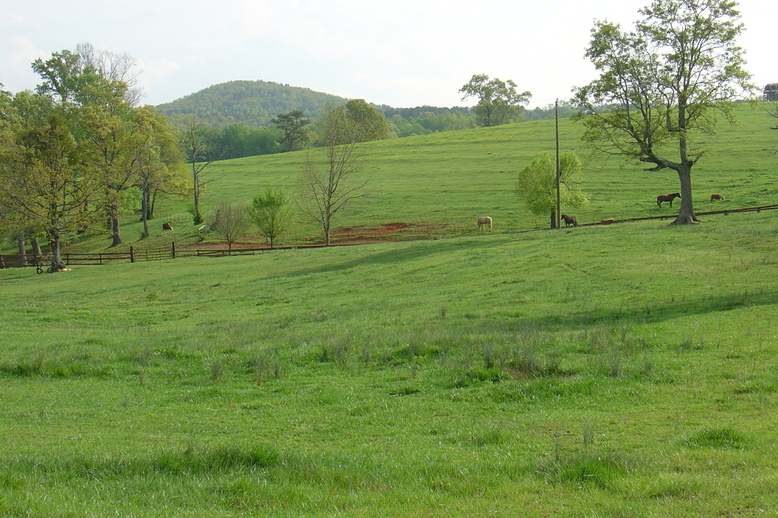
Blackjack Mountain: the green, green grass of home

      In the late 1850s the Widener and Kuglar clan lit out for the territory of Carroll County, what’s been called Georgia’s last frontier. They settled in the furthest reaches of its southwestern corner, nestled against the Alabama line, in Bowdon. The town is situated among the undulating ridges and expansive vistas of the Southern Appalachians. Blackjack Mountain, one of the highest points in Georgia south of Atlanta, stands just south of town and was the sight of trade routes and rituals before the Cherokee were expelled in the 1830s. Bowdon was founded in 1856 and would have counted the Wideners and Kuglars as pioneer citizens. The families homesteaded on neighboring lots in the fledgling hamlet, offspring were produced, the land was cultivated, and there was reason for optimism until the crisis of secession exploded into civil war and sent the Widener brothers to battles far away.

The church sits on a promontory overlooking the Little Tallapoosa River in the Victory community east of Bowdon. Some Wideners are reputedly ensepulchred in the churchyard, but on my visit I encountered neither their granite memorials nor ghostly whispers.

Wednesday, June 6, 2012

From Virginia to Georgia

      My great-great-great-great-great-grandfather Frederick Rainey was born around 1779 in Mecklenburg County, Virginia, to Frederick Rainey and Molly Morgan. They were wed in the same county on May 10, 1775. Frederick Sr. died on October 10, 1803 and in a will dated December 14, 1802 bequeathed to his namesake furniture, a tract of land to be divided among the four sons, and a slave boy named Jack, who was to be freed from servitude on his 25th birthday, January 1, 1816. On September 8, 1806 the county deed book records that Frederick Jr. sold a 110 ¼-acre tract to his brother Smith for $120. Mecklenburg was a spigot of migration in those days, and, having turned land to gold, he looked for prospects southwards.


      The circumstances that led young Frederick to marry Catherine Cabiness (likely also of Mecklenburg) on November 14, 1813 in Putnam County, Georgia, are unclear. Putnam was carved out from Baldwin in 1807 and settled by winners of the 1805 and 1807 land lotteries. A number of Raineys, including Frederick’s uncle Isham, were ‘fortunate drawers’ and were granted lots of 202 ½ acres. These former Creek lands west of the Oconee River were quickly populated and by 1820 Putnam counted 15,000 residents. It seems Frederick joined his kin on the frontier and became a prosperous planter.
When I was a girl how the hills of Oconee
made a seam to hem me in
There at the fair when our eyes caught, careless
got my heart right pierced by a pin
— The Decemberists, 'Yankee Bayonet (I Will Be Home Then)'
      Frederick owned four slaves in 1820, five in 1830, and seventeen in 1840. In 1850 he claimed a real estate value of $7,150. A federal agricultural survey taken in September of the same year lists his land holdings as 700 improved and 200 unimproved acres. The cash value of the farm was reported as $6,600. There were 3,500 bushels of Indian corn, 200 of oats, and 100 of wheat. There were 30 sheep, 100 swine, and nine horses. It was in this antebellum plenitude that Frederick and Catherine raised at least six children, including my great-great-great-great-grandmother.


       Virginia Philip Rainey was born on August 18, 1818, the second oldest child. Her name is a tribute to the land of her parents’ extraction and to her father’s younger brother Philip. Virginia married John J. Glover in Putnam on May 6, 1841. This was not John's first matrimonial endeavor, however. On December 11, 1834 in neighboring Jasper County he wed Christiana Goods, herself a widow. The 1840 census shows him housed with her and their two children, Elizabeth and Henry Harrison. The first Mrs. Glover must have perished because there is no further record of her. In 1850 John and Virginia still resided in Putnam but were soon to relocate to Houston County, where John, a farmer, listed the value of his assets at $1,075 in 1860.
      Virginia's father died in 1855, and her mother followed him five years later. Soon thereafter there was a rupture between Virginia and John, perhaps caused or aggravated by the death of their son in the Civil War. The 1870 census discloses that they were separated. Virginia returned to Putnam and was living in Eatonton. John stayed in Houston and was joined in his household by a woman, Aurilla Glover. It appears they continued to live apart, and in May 1880 John died. In the census conducted the next month Virginia replied that her ‘civil condition’ was ‘widow,’ which complicates the thesis that they were divorced. (Either they divorced, were separated and John did not marry Aurilla, or he committed bigamy.) Virginia died in Putnam or Jasper Counties on June 6, 1891 and is buried in Shady Dale’s only graveyard at Providence Baptist Church. Among the issue of their failed marriage was the youngest of four children, my great-great-great-grandmother Georgia Clifford Glover.

 'We trust in God to meet thee again'

Monday, June 4, 2012

The Young and the Old in Pictures

      Some of the artifacts I most enjoy discovering are photographs featuring four generations of family. These photographs depict a stark contrast between the extremes of age and youth, experience and innocence. The receding light of old age and the promise of new life mingle in the moment captured by the camera. The four seasons of life pictured below bring to mind A. E. Housman’s untitled poem about ageing (first and last stanzas):
When summer's end is nighing
And skies at evening cloud,
I muse on change and fortune
And all the feats I vowed
When I was young and proud.
So here's an end of roaming
On eves when autumn nighs:
The ear too fondly listens
For summer's parting sighs,
And then the heart replies.

 
 This photograph shows my great-great grandfather Julius Ira Delamater (b. 1876) on the left and his mother Georgia Clifford Glover (b. 1853) on the right. In the middle is Julius's son John Ira holding his own son, either John (b. 1921) or Bill (b. 1922).

 This is one of the most remarkable photographs I've come across. On the left is Leonora Smith McKown (b. 1843), draped in a shawl and topped off with some peculiar headgear. Next to her is her daughter Edna Earle McKown Williams (b. 1876), mother of my great-grandfather Hugh, nicely turned-out in a three-piece suit on the right. My great-grandmother Elizabeth (Grandma Williams) is holding their firstborn and only son Hugh Jr., who died at just 20 months in 1925.

 Mattie Jane Potter Tate (b. 1864) is standing in front of the house in Barrow or Jackson Counties she may have lived in, surrounded by her son Alvin and his wife Sudie, their son Edgar and his wife Mary Jane, and my grandmother Bettye (Nana) in sunglasses and a swimsuit. This photograph was made around 1938.

My mother Beth stares quizzically into the camera in this snapshot from around 1961, as my grandfather Thomas Brayton (Pepaw) holds her on his lap. Behind them are (on right) my great-grandmother Grace America Tucker Brayton (Grandma Brayton) and (on left) her mother Emma Eugenia Bridges Tucker (b. 1874).

Grandma Brayton holds me in her lap in this photograph from spring 1986. She is flanked by Mom, Charles Reynolds Brayton (Grandpa Brayton), and Pepaw.

The family is gathered at First Baptist Church of College Park for my dedication in the spring of 1986. Mom and Dad are on left with Grandma Williams in the center. Behind her is uncle Keith and next to her are her daughters Aunt Betty and my grandmother Charlotte (Memaw).