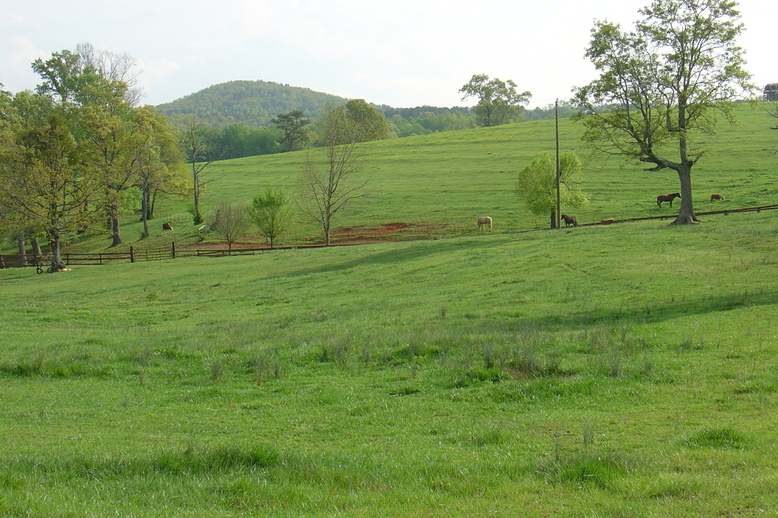
In the countryside southwest of Washington, Georgia, at the end of a rugged gravel road garlanded with yellow wildflowers and spangled with sunbathing butterflies, War Hill rises above Kettle Creek. In this woodland on Valentine’s Day 1779, 400 Patriot militiamen commanded by John Dooly, Andrew Pickens, and Elijah Clarke surprised and defeated a Loyalist force nearly twice their number in the Battle of Kettle Creek. These frontiersmen confirmed the moniker bitterly applied to the area by the British: “hornet’s nest.” Today on the hilltop an obelisk hails the great victory with words etched in stone. In a graveyard across the clearing white marble tombstones memorialize some of the veterans of the fight. This is the final resting place of my great-great-great-great-great-great-great-grandfather Jacob McClendon and his son-in-law, my great-great-great-great-great-great-grandfather William Heard.
Sketch of the Battle of Kettle Creek. The original inscription reads,
"Engagement between the Whigs and Tories."
The McClendons
The unlikely chain of events that would see these two men on the same colonial battlefield began with an oceanic voyage from Europe to the New World. According to the McClendon DNA Project, families with this surname originate in Northern Ireland. This area was called Ulster until 1921, when it was annexed by Great Britain and the rest of the island became independent Ireland. Ulster comprised approximately the same land area as metropolitan Atlanta and was divided into counties. Two of these, County Armagh and southeast County Down, are the earliest geographic origins of the McClendon name, a variant of “McAlinden,” which is the English translation of the Irish Gaelic “Mac Giolla Fhionnain.”
The McClendons first set foot on American soil in present-day northeastern North Carolina. The area was colonized by Virginians moving south in the 1650s. Its reputation developed such that many in the Old Dominion called it Rogues Harbor because it was a haven for debtors and sundry miscreants, yet Quaker missionaries also traversed the region in its early days. The Carolina colony was founded in 1629 and stretched from Virginia to Spanish Florida. A division was made in 1712 between north and south, with the north becoming a royal colony in 1729 after the former proprietors were bought out by the crown. Native American resistance was overcome in several wars as migrant Europeans, many of Scots-Irish, German, and Huguenot derivation, poured into the colony.
Into my
heart on air that kills
From yon
far country blows:
What are
those blue remembered hills,
What
spires, what farms are those?
That is
the land of lost content,
I see it
shining plain,
The
happy highways where I went
And
cannot come again.
—A. E.
Housman
The farthest into history for which the Y-DNA evidence has accounted is Dennis McClendon, born in 1641 in parts unknown (presumably Ulster or Scotland). He and his family settled in this region along the Albemarle Sound and Roanoke River in the 1690s. Part of a deed in Chowan Precinct reads, “Elizabeth Lewerton to Dennis Mackclenden this 3 April 1699 in ye 11th. year of ye Reign of our Sovereign Lord King William of England…” Dennis’ wife Elizabeth, born around 1660, predeceased him, and he remarried. The court of Perquimans Precinct was held at his home in 1704 and 1705 and at the home of his widow Deborah Whedbee McClendon on July 11, 1706, meaning he had expired within the preceding year.
One of Dennis’ sons was Thomas McClendon, born in 1690, possibly in Barbados, a nexus of Atlantic travel and trade. He married Elizabeth Bush in 1716 in Chowan Precinct, the selfsame division where she was born on June 1, 1691. In 1717 there is a record of a “Thos. Macklindon” purchasing land from James Wilson in Chowan Precinct. In 1725 he served as executor of his brother’s will in Bertie Precinct. In 1729 Elizabeth died; Thomas married Mary Bryan the following year. Tax records indicate they moved to the southern end of the Pamlico Sound in Craven County in 1741 and 1742. He died in 1757 in Cumberland County, contemporary site of the city of Fayetteville.

One of Thomas and Elizabeth’s sons was Jacob McClendon, born near the Albemarle Sound in northeastern North Carolina. His tombstone gives his birth year as 1715, the Sons of the American Revolution records put it at 1725 or 1726, still other sources as disparate as 1702, 1730, and 1731. Jacob married Martha Travis, born around 1736 in North Carolina, between 1748 and 1751, and they had eleven children. The births and baptisms of Isaac and Jamima were recorded in 1753 in the register book of Prince Frederick Parish, Winyah, an Anglican church. The next year the French and Indian War began, bringing intermittent battles between the colonists and France’s Native American allies to the frontier. During the war the family probably lived in Cumberland County, about halfway between the coast and the frontier. As the conflict wound down, Jacob was commissioned on March 11, 1761, as a lieutenant in the North Carolina militia in Dobbs County, but a reproduction of the list indicates his name was removed and does not give a reason. In 1774 Jacob set out for the Georgia frontier, where his daughter Nancy, born around 1760, would marry into the Heard family.
The Heards
When personal taxation was imposed in Medieval England surnames became necessary. Various spellings of “Heard” were used by families engaged in herding animals. Some researchers have connected the Heard name to William the Conqueror, but there is no established link to our Heards. We can definitively trace them to Ulster, present-day Northern Ireland, where they were English settlers who spoke the local language. One legend about the Heards claims the paterfamilias was the Earl of Tyrone who, in an argument over tithes, threw a pitchfork at someone and was forced to make haste to America. However, no evidence for this story has been produced.
I’m bidding farewell to the land of my youth
and the home I love so well.
And the mountains so grand round my own native land,
I’m bidding them all farewell.
With an aching heart I’ll bid them adieu
for tomorrow I’ll sail far away,
O’er the raging foam for to seek a home
on the shores of Amerikay.
And when I am bidding my last farewell
the tears like rain will blind,
To think of my friends in my own native land,
and the home I’m leaving behind.
But if I’m to die in a foreign land
and be buried so far far away
No fond mother’s tears will be shed o’er my grave
on the shores of Amerikay.
—Irish folk song
What we do know is there was a Heard man whose first name is lost, born around 1665 in County Tyrone. His sons inscribed the family in the pages of American history when they crossed the Atlantic in 1719-20. One of the sons was Charles, born around 1691 and married in 1718. They settled in Sansbury in Pennsylvania Dutch Country. On August 30, 1744, Charles received a land grant of 225 acres on the South Hardware River, a tributary of the James, in newly-formed Albemarle County, where in the previous year Thomas Jefferson was born. In a 1746 note to creditor Henry Cary we learn that Charles was a blacksmith and able to sign his own name legibly. By July 1748 he was dead, and the will in which he bequeathed his acreage to one of his sons, Charles Jr., was challenged in court by said Cary. Charles Jr. craftily maneuvered to sell the land to his brother, prompting a lawsuit for non-payment of his father’s debts. The court ordered the seizure of his property, in this case an iron knife and ring, which by the time they were sold by the sheriff in 1749 Charles Jr. and his family had evacuated the state and fled to Carolina.
Charles Jr. was born around 1718 in County Tyrone and married Isabella in the early 1740s in Pennsylvania. They had six boys and one girl from 1743 to 1764. After their abrupt relocation to North Carolina they lived on 100 acres in Cumberland County. Through the 1750s and 60s Charles Jr. bought and sold hundreds of acres and served on several juries. In April 1768 he again fell into debt, and his property was seized. This latest entanglement saw him decamp to South Carolina, wherefrom in October 1768 he deeded 100 acres to one of his sons in exchange for fifteen pounds. The militia roll call in his former home county pointedly described the fiasco when in November 1770 it declared him to be “gone.” Charles Jr.’s dubious sojourn in the Palmetto State ended when he moved to Georgia. His departure for the thirteenth colony coincided with that of the McClendons. Both families lived in Cumberland County at the same time, and they became neighbors again in the frontier forests on the western bank of the Savannah River.
 Wilkes County
The land settled by the McClendons and Heards and thousands of other adventurous pioneers was originally Cherokee and Creek territory. A 1763 treaty between the Southern colonies and the natives limited settlement to south of the Little River. Subsequent commerce between traders and natives left the latter owing about £60,000. Sir James Wright, the royal governor, seized the opportunity and convened a congress on June 1, 1773, at which the Creek and Cherokee ceded two million acres in a wide swath along the western banks of the Savannah River extending northward to the confluence of the Keowee and Tugaloo Rivers. The land, known as St. Paul’s Parish until it was divided into counties, was opened for settlement in parcels from one to 100 acres. Farmers of good character were exhorted to tame the wilds and were assured the soil was suitable for indigo, Indian corn, cotton, tobacco, flax, and hemp. On December 7, 1773, at Wrightsborough, a Quaker community near Augusta, Charles Heard Jr. received his tract: “Herd, Charles--S. C. a wife 2 sons and 1 dau. from 17 to 9 years old. 200 acres on head of Fishing creek at Isaac Goldsbee's cabbin.” Jacob McClendon was granted land on October 10, 1774, at Dartmouth, later known as Petersburg, in the fork of the Broad and Savannah Rivers: “McClendon, Jacob--N. C. a wife 4 sons and 4 daus. from 18 to 1 years old. xxx acres on Fishing creek including xxx acres surveyed for Thomas Richardson including improvements made by Richardson and Nemh. Killcres.”

Stephen Heard and his horse Silverheels, from the 1913 collection
"Grandmother Stories from the Land of Used-to-Be" by Howard Meriwether Lovett
Charles Jr.’s first cousin Stephen Heard, born in 1740 and a veteran of the French and Indian War, also settled in the ceded lands along with his father and brothers. The family came from Virginia where their land abutted the property of George Washington, from whom they purchased Arabian horses. On New Year’s Day 1774 the family and other settlers began constructing a stockade on the future site of Washington called Fort Heard or Heard’s Fort. Stephen homesteaded north of there on Fishing Creek. Jacob McClendon and Charles Jr. also settled the area, which today is ten miles north of Washington near the ghost town of Danburg. On February 5, 1777, a convention at Savannah officially named the land Wilkes County in honor of the British parliamentarian and proponent of the American cause John Wilkes.
Soon after the conference a party of surveyors, chain
carriers, markers, artisans, guards, and astronomers, as well as a few adventurers
and Indian braves, set out from Augusta. Crossing Little River, the company
entered a country of magnificent forests abounding in deer, black bear, wolf,
wildcat, and such small game as squirrel and rabbit. Quail rose whirring from
the underbrush, and the clear, rapid streams were full of fish.
—Writers of the Works
Progress Administration, The Story
of Washington-Wilkes, 1941
This territory, called the
New Purchase, contains about two millions of acres, lying upon the head of
Great Ogechee, between the banks of the Savanna and Alatamaha, touching on the
Ocone and taking within its precincts all the waters of Broad and Little
rivers, comprehends a body of excellent fertile land, well watered by
innumerable rivers, creeks and brooks.
—William
Bartram, Travels, spring 1776
The frontier in those days was hardly peaceful. Besides the outbreak of war there were Cherokee and Creek raids, one of which in 1777 resulted in Charles Jr.’s house being burned down, his property and belongings ransacked, and a slave woman stolen. In 1802 his sons were still seeking restitution in court. In January 1779 Augusta fell to the British, and the maneuvers which culminated in the Battle of Kettle Creek began. After the Patriot victory there Wilkes County was delivered from further British and Loyalist incursions. The county’s attitude towards the revolution was made clear when the first court met at Jacob McClendon’s house on August 25, 1779. Nine Loyalists were sentenced “to be hanged by the Neck till their bodies are Dead.” The following year Heard’s Fort was called Washington, the first city named for the revolutionary hero. On February 5, 1780, it was declared Georgia’s seat of government, and on February 18 Stephen Heard was elected acting governor for a one-year term.
One of Charles Jr.’s sons William, born around 1751 in North Carolina, had also won a land grant of 100 acres and settled at Fishing Creek. He accumulated and sold hundreds of acres during and after the war, and around 1779 he married Jacob McClendon’s daughter Nancy. Charles Jr. lost his wife in this period and remarried a landowning widow, Margaret Brady. In Wilkes County’s first tax digest in 1785 it records he owned 615 acres there and another 200 in Greene County. Charles Jr. died in late 1797, and to his wife he left:
…my riding horse, Britton, also two cows, white, black and white face, together with the increses that they have had and to come. Also my household furniture, my feather bed excepted and bed quilt, also I give to my said wife the tract of land I now live on, all at her disposal, also I lend to my said wife my negro woman, named Rody, also my negro man, named Mingo, during her widowhood, providing that said negros are not moved out of this state.
In 1793 Jacob died and in his will divided his estate of more than a thousand acres and many slaves among his sons; to his daughter Nancy he bequeathed £25 payable in tobacco. His wife Martha lived for many more years in Wilkes County and died there in 1827. Nancy’s death followed on her father’s in the late 1790s, and William remarried Rachel Griffin, with whom he had several children. They moved to Harricane Creek in Jackson County in 1814. William died there in 1825.
One of William’s daughters with his first wife was named Nancy, born on July 29, 1785. She had a brief marriage to Azariah Bostwick before he died as a young man, and she lived most of her nine decades as a widow. She died on July 2, 1876 and is buried at Macedonia Baptist Church in Oxford. Nancy Heard Bostwick was the great-great-grandmother of my great-grandmother Grace Tucker Brayton, yet there is no indication she or anyone else in our immediate family knew of this branch of their family tree. In 1790 Wilkes County contained one-third of Georgia’s population and counted as residents Meriwether Lewis and Eli Whitney, but today the area is depopulated and remembered mostly for its rich history. Now that we know about our Heard and McClendon ancestors we can remember our own connection to this rich history.